
Standard Book Sizes and KDP Trim Sizes, With a Chart
 Proselis TeamPosted on October 18, 2026
A book’s trim size is its width and height after printing. The printer prints your pages on bigger sheets. Then it cuts, or trims, them down to this size.
KDP, short for Kindle Direct Publishing, is Amazon’s service for publishing your own books. When you set up a paperback on KDP, you choose its trim size. KDP’s help page Set Trim Size, Bleed, and Margins says the most common trim size for US paperbacks is 6 × 9 in.
Trim size changes more than how your book looks. It changes what each copy costs to print, how many pages your book has, and how thick it is. This guide shows the sizes KDP offers, drawn to scale, with the math for each choice. The facts come from Amazon’s KDP help pages as of October 2026.
How do I set the trim size on KDP?
KDP writes trim size as width × height. A 6 × 9 in book is 6 inches wide and 9 inches tall.
You choose it in the Print Options section of your paperback’s Content tab. KDP selects 6 × 9 in for you at first. To change it, click Select a different size.
Set the page size in your manuscript file to match the trim size. In Microsoft Word, that setting is called the paper size. A book with bleed, meaning images or color that run off the edge of the page, is the one exception.
KDP trims 0.125 in, an eighth of an inch, from the top, bottom, and outside edge of every page. The inside edge, where the pages are glued to the cover, isn’t trimmed. That means a 6 × 9 in book with bleed needs pages 6 + 0.125 = 6.125 in wide and 9 + 0.125 + 0.125 = 9.25 in tall.
What paperback trim sizes does KDP offer?
The chart shows six of KDP’s paperback sizes at the same scale. The three on the left are regular trim sizes, which are no wider than 6.12 in and no taller than 9 in. The three shaded sizes are large trim sizes, which are wider or taller than that and cost more to print.
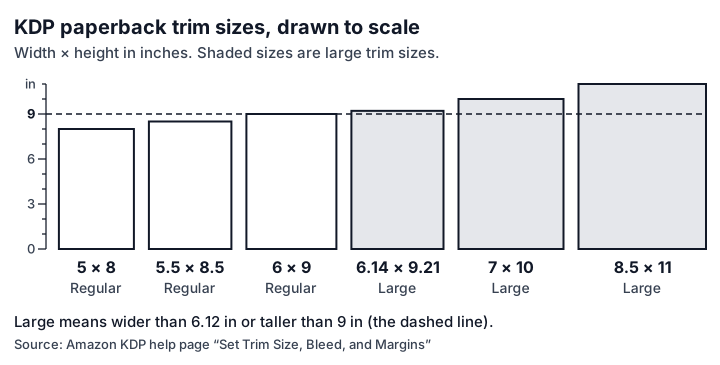
KDP’s US site, kdp.amazon.com, lists 16 paperback trim sizes. Here are all of them.
| Size (in) | Size (cm) | Cost group |
|---|---|---|
| 5 × 8 | 12.7 × 20.32 | Regular |
| 5.06 × 7.81 | 12.85 × 19.84 | Regular |
| 5.25 × 8 | 13.34 × 20.32 | Regular |
| 5.5 × 8.5 | 13.97 × 21.59 | Regular |
| 6 × 9 | 15.24 × 22.86 | Regular |
| 6.14 × 9.21 | 15.6 × 23.39 | Large |
| 6.69 × 9.61 | 16.99 × 24.41 | Large |
| 7 × 10 | 17.78 × 25.4 | Large |
| 7.44 × 9.69 | 18.9 × 24.61 | Large |
| 7.5 × 9.25 | 19.05 × 23.5 | Large |
| 8 × 10 | 20.32 × 25.4 | Large |
| 8.25 × 6 | 20.96 × 15.24 | Large |
| 8.25 × 8.25 | 20.96 × 20.96 | Large |
| 8.5 × 8.5 | 21.59 × 21.59 | Large |
| 8.5 × 11 | 21.59 × 27.94 | Large |
| 8.27 × 11.69 | 21 × 29.7 | Large |
The last size, 8.27 × 11.69 in, is A4. That’s the standard size of printer paper in most countries outside the US and Canada.
You can also enter your own size. KDP’s Print Options page says a custom paperback can be 4–8.5 in wide and 6–11.69 in tall.
Is there a standard book size?
No single size is standard for every book. KDP names only one size as the most common in the US, and that size is 6 × 9 in.
Other sizes are common for certain kinds of books. Amy Collins is the president of New Shelves Books, an agency that sells books to stores and libraries for publishers. She checked the trim sizes of bestsellers on the USA Today, New York Times, and Amazon lists. She shared the results in a December 2021 IngramSpark blog post, Picking a Popular Trim Size for Your Book. IngramSpark is another company that prints books when readers order them.
Here are some of the most common sizes she found that KDP also offers.
| Kind of book | Common size (in) |
|---|---|
| General fiction | 6 × 9 |
| General nonfiction | 5.5 × 8.5 |
| Thrillers and mysteries | 5.25 × 8 |
| Memoir | 5.25 × 8 |
| Middle-grade fiction | 5 × 8 |
| Reference | 6 × 9 or 7 × 10 |
| Children’s picture books | 8.5 × 8.5 |
Treat this as one survey from 2021, not a rule. Collins also suggests checking the sizes that today’s bestsellers in your genre use.
Which KDP trim sizes are regular and which are large?
KDP sorts every size into two cost groups. A large trim size is wider than 6.12 inches or taller than 9 inches. Every other size is a regular trim size.
Of the 16 sizes in the table, only five are regular: 5 × 8, 5.06 × 7.81, 5.25 × 8, 5.5 × 8.5, and 6 × 9 in.
Small differences matter. The size 6.14 × 9.21 in is only 6.14 − 6 = 0.14 in wider and 9.21 − 9 = 0.21 in taller than 6 × 9 in. It’s still large because 6.14 is more than 6.12 and 9.21 is more than 9. The size 8.25 × 6 in is only 6 inches tall, but it’s large because it’s 8.25 inches wide.
How much more does a large trim size cost to print?
The printing cost is what KDP charges to print one copy. You don’t pay it up front. KDP subtracts it from your share of each sale, and what’s left is your royalty, the money you earn.
Your page count is the number of pages in your printed book. Each sheet of paper holds two pages, one on each side. KDP rounds an odd count up to the next even number.
Most black-ink books print on white or cream paper. For those with more than 110 pages, KDP uses this formula: fixed cost + (page count × per-page cost) = printing cost. The fixed cost is charged once for each copy, and the per-page cost is charged for every page.
| Black ink on Amazon.com | Regular size | Large size |
|---|---|---|
| Fixed cost per copy | $1.00 | $1.00 |
| Cost per page | $0.012 | $0.017 |
Now take a 300-page book printed in black ink.
- At 6 × 9 in, a regular size, it costs $1.00 + 300 × $0.012 = $1.00 + $3.60 = $4.60.
- At 6.14 × 9.21 in, a large size, it costs $1.00 + 300 × $0.017 = $1.00 + $5.10 = $6.10.
The large size costs $6.10 − $4.60 = $1.50 more for every copy.
Your list price is the price you set for your book on Amazon. On Amazon.com, KDP pays 60% of a list price of $9.99 or more, minus the printing cost. Below $9.99, it pays 50%.
KDP rounds printing costs and royalties to the cent. At a $14.99 list price, 60% is 0.60 × $14.99 = $8.994.
- At 6 × 9 in, the royalty is $8.994 − $4.60 = $4.394, which rounds to $4.39.
- At 6.14 × 9.21 in, the royalty is $8.994 − $6.10 = $2.894, which rounds to $2.89.
The large size earns $4.39 − $2.89 = $1.50 less on every sale. Our KDP royalty calculator does this math for any size, page count, and Amazon store.
Short books have a flat printing cost. A black-ink book with 24–110 pages on white or cream paper costs only a fixed amount. On Amazon.com, that’s $2.30 at a regular size or $2.84 at a large size.
Color ink costs more per page, and a large size raises the cost even more. KDP offers two kinds of color ink. Standard color uses inkjet printers and the same paper as black-ink books. Premium color prints sharper color on heavier paper. Here’s the same 300-page book in each.
- Standard color at 6 × 9 in costs $1.00 + 300 × $0.0255 = $1.00 + $7.65 = $8.65.
- Standard color at 6.14 × 9.21 in costs $1.00 + 300 × $0.0402 = $1.00 + $12.06 = $13.06.
- Premium color at 6 × 9 in costs $1.00 + 300 × $0.065 = $1.00 + $19.50 = $20.50.
- Premium color at 6.14 × 9.21 in costs $1.00 + 300 × $0.08 = $1.00 + $24.00 = $25.00.
Why do some KDP pages say trim size doesn’t change the cost?
KDP’s help pages contradict each other here. The Paperback Royalty page and the Print Book Pricing Page both say that trim size doesn’t affect printing cost.
The Paperback Printing Cost page says the opposite. Its tables list a higher per-page cost for large sizes. The Print Options page agrees with the tables. The Paperback Royalty page says both things.
Trust the cost tables. They list the actual prices. KDP also shows your book’s printing cost in the Rights & Pricing section when you set up your paperback.
How many pages can each trim size hold?
Every KDP paperback needs at least 24 pages, or 72 for standard color. The most pages you can have depends on the trim size and the paper.
A black-ink book can use white, cream, or groundwood paper. Groundwood is a lighter-weight paper with a textured feel. Cream paper is a little thicker than white. KDP says groundwood costs about 5% less per page than white or cream. KDP also says it makes novels and other text-heavy books easier to read.
Here are the most pages KDP’s Paperback Submission Guidelines allow for black ink.
| Size (in) | White (pages) | Cream (pages) | Groundwood (pages) |
|---|---|---|---|
| Up to 8 in wide | 828 | 776 | 812 |
| 8.25 × 6 and 8.25 × 8.25 | 800 | 750 | 784 |
| 8.5 × 8.5 and 8.5 × 11 | 590 | 550 | 578 |
| 8.27 × 11.69 (A4) | 780 | 730 | 764 |
Color ink has its own limits. Standard color allows 72–600 pages at every size except A4, where KDP doesn’t offer it. Premium color needs at least 24 pages. Its page limit matches the white-paper column at every size except A4, where it stops at 590 pages.
Which trim sizes allow color ink?
Each ink works at these sizes and on these papers.
- Black ink works at every size on white, cream, or groundwood paper.
- Standard color works at every size except A4, on white paper only.
- Premium color works at every size on white paper only.
KDP’s Color Ink Options page suggests standard color for books with many pages and fewer images. It suggests premium color for image-heavy books like children’s books, cookbooks, and photography books.
After you publish, KDP won’t let you switch between black ink, standard color, and premium color.
How does trim size change page count and spine width?
A smaller page holds fewer words. That means a book needs more pages at a smaller size.
Our word count to pages calculator estimates the page count for each size. At an 11-point font size, an 80,000-word novel fills about 346 pages at 5.5 × 8.5 in. At 6 × 9 in, the same novel needs only about 292 pages.
The spine is the narrow strip of cover that wraps around the glued edge of the pages. KDP calculates its width from the page count and the paper. On cream paper, each page adds 0.0025 in.
- At 5.5 × 8.5 in, the spine is 346 × 0.0025 in = 0.865 in wide.
- At 6 × 9 in, the spine is 292 × 0.0025 in = 0.73 in wide.
More pages also cost more to print. Both sizes are regular, at $0.012 a page.
- At 5.5 × 8.5 in, the novel costs $1.00 + 346 × $0.012 = $1.00 + $4.152 = $5.152, which rounds to $5.15.
- At 6 × 9 in, the novel costs $1.00 + 292 × $0.012 = $1.00 + $3.504 = $4.504, which rounds to $4.50.
For this novel, the smaller size costs $5.15 − $4.50 = $0.65 more for every copy.
Your paperback’s cover is one image that wraps around the back, the spine, and the front. That means the spine changes your cover size. KDP’s formula for cover width is bleed + back cover + spine + front cover + bleed. Every KDP cover needs 0.125 in of bleed on each edge.
For the 6 × 9 in novel on cream paper, the cover is 0.125 + 6 + 0.73 + 6 + 0.125 = 12.98 in wide. It’s 0.125 + 9 + 0.125 = 9.25 in tall. Our KDP cover calculator calculates this for any size and page count.
How do I choose a trim size for my KDP paperback?
- No reason to pick another size? Choose 6 × 9 in. It’s the most common US size, and it’s the biggest regular size. Bigger pages mean fewer pages, and each page costs the lower regular rate.
- Want a small book that fits in the hand? The sizes 5 × 8, 5.25 × 8, and 5.5 × 8.5 in are regular too. Expect more pages, a thicker spine, and a slightly higher printing cost.
- Need room for pictures or worksheets? Sizes like 7 × 10, 8 × 10, and 8.5 × 11 in give you bigger pages. They’re large sizes, and they cost more per page.
- Want bookstores and libraries to order it? Turn on KDP’s Expanded Distribution. KDP then offers your paperback to the distributors that stores and libraries buy from. With black ink on cream or groundwood paper, only 5 × 8, 5.25 × 8, 5.5 × 8.5, and 6 × 9 in qualify. The sizes 8.25 × 6 and 8.25 × 8.25 in don’t qualify with any ink or paper.
- Planning a hardcover too? KDP prints hardcovers in only five sizes: 5.5 × 8.5, 6 × 9, 6.14 × 9.21, 7 × 10, and 8.25 × 11 in. The first four are also paperback sizes. Pick one of them if you want both editions the same size.
Before you publish, order a proof copy, a test print of your book. KDP recommends one to check that your choices look right in print.